Category: Spring 2008

Letter from the Editors

By Andrea Zeffiro, Kim Sawchuk, Barbara Crow, and Michael Longford

Welcome to the inaugural issue of Wi: Journal of Mobile Media.

The theme of this first issue, “Pedestrian Traffic,” reaffirms the centrality of mobilities research and practice to the journal at the same time as it alludes to a subtle shift in Wi’s identity this year. In its previous incarnation as Wi: The Journal of the Mobile Digital Commons Network, the journal highlighted the experiences of the Mobile Digital Commons Network (MDCN). The MDCN no longer exists, but Wi: Journal of Mobile Media will uphold its original mandate. Wi will continue to engage with disciplines such as design, engineering, computer science, communications and media studies, and publish the latest in international scholarship, artistic productions and design research on mobility, wireless technologies, and digital media.

A Door to the Digital Locus: Walking in the City with a Mobile Phone and Michel de Certeau

By Fabio B. Josgrilberg

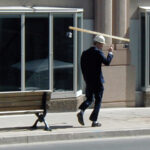
A city offers us many places wherein life enfolds. We take the idea of place in Michel de Certeau’s sense: a “proper space” wherein its elements are organized in a relatively stable form, an “instantaneous configuration of positions”. Such an organization, which can be purely symbolic but also material, is articulated by strategies founded on specific relations of power (Certeau, 1990, p. 172-173). What of the places created by information and communication technologies (ICT)? What is the role of the mobile phone in all this? Let me further the discussion with a few examples from everyday life before returning to the mobile phone in the context of ICT.

Registering Realities, Parasiting Networks: An Interview with Antoni Abad

Interview conducted by Kim Sawchuk

Antoni Abad is a Catalan artist whose “canal” projects, broadcast on his website http://www.zexe.net, are intensive short-term collaborations with various diasporic communities. Cab drivers in Mexico City, moto-boys in Sao Paulo, sex-workers in Madrid, the Roma people (gypsies) in Leida, Catalonia, Nicaraguan immigrants living in Costa Rica and most recently handicapped participants in wheelchairs in Barcelona and Geneva have been given camera-phones to produce alternative images of and for their communities. These images are then transformed into flyers, posters, post cards and most importantly, they are broadcast on the World Wide Web using open source software developed by Abad and his team for the project.

Pedestrian Thoughts: Waiting in the Street Looking Squatting Filming Taking Time

By Robert Prenovault

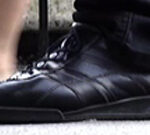
The intimate and the impersonal. Ces prises de vue soulignent la tension entre l’intime et l’impersonnel. Elles confrontent l’image de l’espace public à l’apparition soudaine, en gros plan, des pieds des passants. Impersonal, because here are images of the street which belong to everyone. Generic, because there are few if any hints of where this might be. The content is slightly dislocated. La rue appartient à tous, surtout quand elle nous est présentée de cette façon, à ras le sol, sans indices susceptibles d’identifier les lieux. Aussi, on ne voit que les pieds des passants, sans faces et sans corps qui pourraient les identifier.

Street Level Conversations: On the Urban Interventions of Stephan Schulz

By Jennifer Dorner

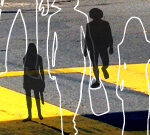
Our daily commutes are rarely disrupted by the unexpected. Walking to and from work is usually the same, a solemn and private mental space. Sometimes it’s raining and cold and our pace is quickened while other times its warm and sunny and we take the time to stroll, look into store windows and watch the people around us, usually all doing the exact same thing that we are. Now and then we walk past something out of the ordinary, such as a fire being doused by firefighters, or a three-legged dog with a plastic cone shaped around its head.

What Else Do We Lose When We Make People Disappear? The Passage Oublié Project

By Maroussia Lévesque & Jason Lewis

We are all suspects in airports. Post 9-11 fears have generated security measures where individuals are scrutinized, searched and profiled at airports gates. Although these searches vary from the ‘enhanced interrogation techniques’ in secret prisons, the bottom line argument is identical: better safe than sorry. For this reason, passengers at the Pearson airport are in a particularly conducive position to reflect upon the ramifications of the preemptive war rhetoric.