
Category: Spring 2009

The Micro Radio Project

By Kristen Roos

In the essay “Cultural Confinement”, published in the October 1972 issue of Artforum, Robert Smithson writes on what he feels is a need for artists to create works of art that are outside of the gallery and museum systems.

Artists themselves are not confined, but their output is. Museums, like asylums and jails, have wards and cells—in other words, neutral rooms called “galleries.” A work of art when placed in a gallery loses its charge, and becomes a portable object or surface disengaged from the outside world. (Fabozi 2002, p.248)
SUR-VIV-ALL: Locative Art

By Marilei Fiorelli, Andre Lemos, and Rob Shields

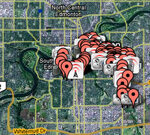
SUR-VIV-ALL in Edmonton is a GPS writing project in which traces are made on Google Maps using a GPS logging device to track an itinerary. Here we present a new class of art – locative art — which mobilizes locative media and articulates the relationship between it and everyday life and embodiments in place. These terms will be explored in more detail below.

The Hollins Community Project: New Media, Narrative, and Affective History

By Jen Boyle and Alli Crandell

A group of women place heavy stones on a trail, at even intervals. These stones will guide the women and their children to the college where they serve as body slaves. The trail connects the closest clearings between the slave community and the campus, but the path is long enough that the children could get lost. A century later, the stones, along with the stories of the women and children, are scattered. Some of the stones have been moved to prop up statues in the adjacent field, while others are used to create a border around a community garden. The children of slaves, college employees, students, and artists have traversed this trail. Over time, these various paths and narratives converge, diverge, and fade.

Blurred and playful intersections: Karmen Franinovic’s Flo)(ps

By Marie-Hélène Lemaire

Amplified Intimacies, curated by Lynn Hughes and Jean Dubois,1 was a group exhibition presented at Montreal’s Oboro Gallery from September 13-October 18, 2008. Bringing together a range of works taken from media arts, experimental architecture, fashion design, and interactive game design the exhibition explored the interpersonal interactions and spaces that are increasingly sculpted by digital technologies and communication networks. Flo)(ps, produced by architect, artist and interaction designer Karmen Franinovic,2 was part of that exhibition.