
Interviewer: Allison Ferry
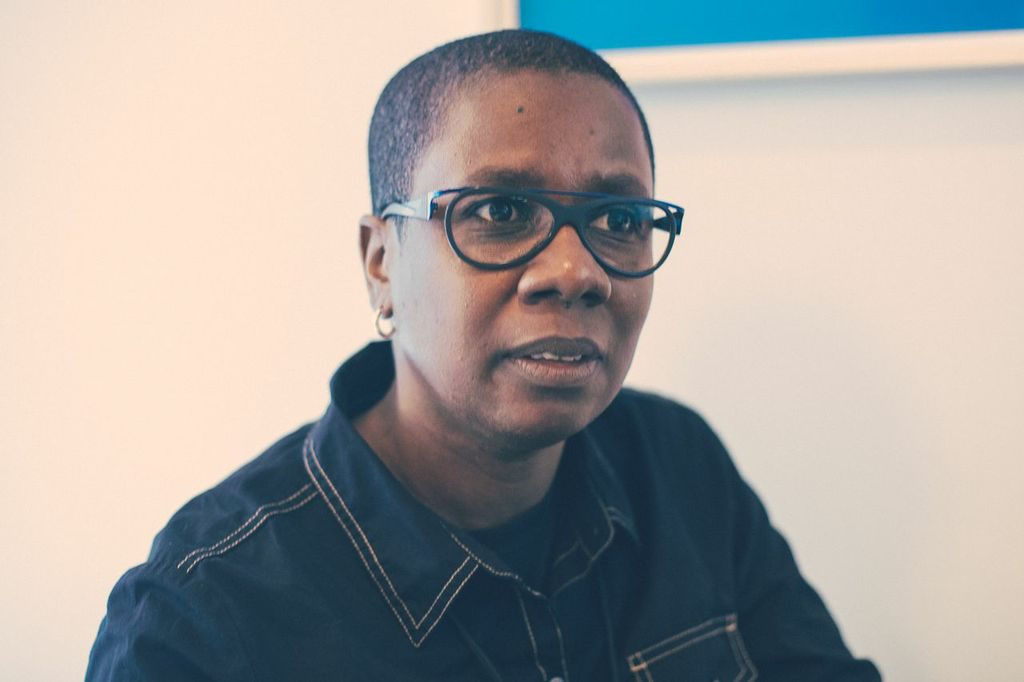
Judith A. Nicholson (PhD), an Associate Professor of Communication Studies at Wilfrid Laurier University (Canada), has published on mobilities and race and on mediated mobilities in The Routledge Companion to Mobile Media (2014), Mediascapes: New Patterns in Canadian Communication (2013; 2010), The Wireless Spectrum: The Politics, Practices & Poetics of Mobile Media (2010), Canadian Journal of Communication (2008) and Fibreculture Journal (2006).
When did you first become involved with mobilities research?
I think it was when I was writing my master’s thesis. I was at Concordia University and looking at urban tales around cell phone use. Probably the most well-known one is when, you know, this idea that in the past that if you used your cell phone at a gas station the pump would explode.
What does mobilities mean to you?
Mobilities is a very exciting area of research, but what it means to me is, it looks like communication studies, to me. It’s a new way of talking about the convergence of a variety of disciplines. So it’s an interdisciplinary area that’s talking about new ways of communicating.
I teach a course on mobilities and I’ve been teaching it for about five years. And so I talk about contemporary practices that a lot of people, a lot of my students and just people in general are familiar with – contemporary practices like cell phone use – but I use mobilities research to talk about the history of communication. So for example, how bodies and technologies and people move about.
How does race appear in mobilities research?
I think race appears in a number of ways, but I’ll name three of them. I think race appears in studies of racialized bodies moving around. So, for example, Mimi Sheer writes about the mobility of white tourists who go to nations, where they’re mostly racialized people. And then she also talks about the immobilities of those racialized bodies working in service industries.
Tim Cresswell also writes in his book On the Move about racialized bodies and how they are, those bodies are particularly regulated. There are also very specific concepts within the mobilities paradigm where race is implied. So, for example, in the concept of the nomad, and I saw a fantastic paper, it was on the panel I presented on, by Esteban Cabanzo, and he was talking about how the nomad, the figure of the nomad, has been emptied of its racialized connotations, but it’s so central to the paradigm because it’s one half of the binary between those of us who move and those of us who do not move.
The third way in which I think race is evident in the mobilities paradigm is in terms of a gap. I think there’s a lack of focus on whiteness even though it’s there implicitly, particularly in some of the origin stories, but it’s also there implicitly in terms of the social location of researchers. This field for the moment is actually quite white in terms of its Western, its European, its North American perspective, which is one of the beautiful things about this conference is that we’ve started to talk about whiteness and racialization in the research that’s emerging these days.
How is race present in ideas of mobile technologies?
Well, I think race is present in a couple of ways. One, in terms of who are the innovators who are celebrated. So just recently, I saw Martin Cooper on the television because he was the inventor of the cell phone, 1973. And so he’s held up as one of these creators. And along with Martin Cooper in our contemporary era, there are other white men who are celebrated as innovators, and they have actually done very interesting work. So for example, Steve Jobs and his association with Apple and the iPhone.
So there are these contemporary figures who seem like innovators, but if we look historically at the origin stories, the most well-known, celebrated user of mobile technologies is Dick Tracy. Recently, there’s some companies that have been releasing, or saying that they’re going to release, smart watches. And every time those announcements come up, Dick Tracy is mentioned because he is mentioned as the first user of a mobile technology in the comic strip from the 1930s and 40s when his creator, Chester Gould gave him this phone watch.
And so we see the figure of Dick Tracy, who’s mentioned over and over again in news, even in academic studies, on technology blogs. And what it means is that we are forever holding up this figure of this fictional hero as the exemplary and first user of these mobile technologies. Well, Dick Tracy was a law and order figure who, in his comic strips, meted out this brutal brand of racist violence at a time when there were these awful stereotypes of people who are othered.So as we’re celebrating this Dick Tracy, we forget the context in which this fictional hero became popular, and it keeps happening. We’re now 70, 80 years away from Dick Tracy, but he remains the main figure – it’s almost like he is the father of mobile technologies, even though he’s not real.
So I think race is evident in the mobilities paradigm also because, as a lot of critical race scholars have emphasized, race is never not a factor. So even when we’re not talking about race, it’s actually there in terms of where we put our focus as researchers. So in the early years of doing mobilities research, there were quite a lot of European and North American researchers who turned their focus to Asia and did so with a somewhat techno-orientalist lens, in that they were looking to Asia to see what the future of mobile communication would be in North America. And it’s only recently that some of that gaze has been criticized. I also think that race is never not there because as researchers, sometimes we don’t acknowledge our own race and our own social location and how our experiences shape the kind of research that we do.
And I think this will come to the forefront more and more as we engage in participatory action research (PAR), which calls for researchers to really acknowledge who they are as they’re sort of co-creating research with participants. And at this conference, I’ve heard an awful lot of work that is sort of based in PAR and in ethnographies and I think more and more we’ll talk about who we are in the research that we’re doing and how as we’re moving with our research, how our research moves us.