
By Andrea Zeffiro, Kim Sawchuk, Barbara Crow, and Michael Longford
Welcome to the inaugural issue of Wi: Journal of Mobile Media.
The theme of this first issue, “Pedestrian Traffic,” reaffirms the centrality of mobilities research and practice to the journal at the same time as it alludes to a subtle shift in Wi’s identity this year. In its previous incarnation as Wi: The Journal of the Mobile Digital Commons Network, the journal highlighted the experiences of the Mobile Digital Commons Network (MDCN). The MDCN no longer exists, but Wi: Journal of Mobile Media will uphold its original mandate. Wi will continue to engage with disciplines such as design, engineering, computer science, communications and media studies, and publish the latest in international scholarship, artistic productions and design research on mobility, wireless technologies, and digital media.
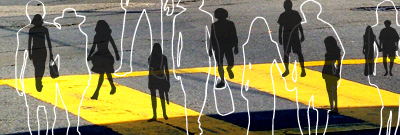
This issue brings together international artists and researchers, whose work contributes, in varying forms, to the theme of ‘pedestrian traffic.’ As the pieces in this issue demonstrate, pedestrian traffic is inherently multifarious both in theory and practice, and in the technical and non-technical possibilities it yields.
The issue begins with Fabio B. Josgrilberg’s piece, “A door to the digital locus: walking in the city with a mobile phone – and Michel de Certeau,” which contemporizes Michel de Certeau’s infamous pedestrian figure by equipping her with a mobile phone as she carries on in everyday life. Emerging from this fashioning is, as Josgrilberg explains, the idea of a digital locus – a metaphorical space that evolves through the everyday practices that may or may not involve mobile telephony, including other technological systems and previous forms of social and physical organizations. For Josgrilberg who is writing from the context of Brazil, mobile phone users have the capacity to operate outside of bureaucratic structures that regulate, in varying capacities, cellular communication systems. In turn, the potential for appropriation resides in the multiplicity of practices offered to and carried out by mobile phone users.
Kim Sawchuk’s interview with Antoni Abad, a Catalan artist whose projects provide mobile camera phones to diasporic communities, echoes Josgrilberg’s claim for the appropriation of mobile phones for alternative practices that challenge the existing dynamics of media power and access. Abad’s projects allow for various disenfranchised groups to produce images of and for themselves. In collecting these documentary images and showcasing the work on the internet, Abad provides a measure of visibility to groups that otherwise may not have had access to print media or the internet, providing a mobility beyond that of the phone itself.
In “Waiting in the street looking squatting filming taking time,” Robert Prenovault poetically recounts his visual thought experiments carried out in an urban centre with his pocket digital camera. Prenovault’s videos summon Dziga Vertov’s “Man With a Movie Camera,” yet in place of Vertov’s roaming eye is Prenovault’s terranean kino-eye, capturing and sustaining the pieds-a-terre movements of the urban symphony. While Vertov ‘s camera, much like the notations on a musical staff creates the impulses and tones of the city, Prenovault’s camera in contrast is the staff providing the structural framework onto which the rhythms of the city assemble in consonance.
Jennifer Dorner eloquently describes the work of Stephan Schulz, another artist intent on working at ground level. To label Schulz as a performance artist merely touches on the one dimension of his work. He is deeply indebted to appropriating and modifying commonplace technologies into roaming sculptural performances. In combining these elements, Schulz is more of a strategic urban interventionist whose works seeks to disrupt the habitual flow of everyday pedestrian flow, precisely by encouraging and sometimes demanding street level conversations between strangers. As an artist/interventionist, perhaps it is even fitting to add conversationalist to the bill, Schulz straddles the art world/gallery space and the public/urban space and creates pieces and performances that are dialogic in intent. And for those who are less interested in conversation, there is pleasure in witnessing his mesmerizing sculptures.
An early maker of locative media and long term art practitioner and scholar, Paula Levine reflects on the “old” and the “new” in locative media. Levine is interested in how to make the local and place visible in the digital ephemera. In “Spatial Dissonance, Subjective Imagination and Locative Media,” Levine speculates on how these ideas have been taken up in playful and important ways for us to imagine and play with new locative media practices. Artist, scholar and pathbreaking practitioner of locative media, Paula Levine reflects on the usage of the adjectives ‘old’ and the ‘new’ in the discourse of locative media. Levine’s projects and reflections emphasize the local and the persistence of place in the realm of digital ephemera. In “Spatial Dissonance, Subjective Imagination and Locative Media,” Levine speculates on how the ideas, hinted at in the title, have been adapted to offer a playful, imaginative –yet politicized– engagement with new locative media practices.
In other instances, as Maroussia Lévesque and Jason Lewis argue, pedestrian traffic is also the regulated and surveyed practices associated with the trafficking and policing of (pedestrian) bodies. In “What Else Do We Lose When We Make People Disappear? The Passage Oublié Project,” Lévesque and Lewis describe a recent Obx Lab installation at Toronto’s Pearson International Airport, July 2007 to May 2008. The project, which consists of touch screen kiosks, is aimed to engage individuals – predominantly airline passengers – in a series of prompts concerning the secret detention – or extraordinary rendition – of suspected terrorists. The project, in recreating rendition flight paths, addresses the global and fluid nature of this network. In bringing into focus the highly secretive practices carried out in highly trafficked spaces, “Passage Oublié” or “Forgotten Passage” demands that we not forget.
The authors and artists in this issue illustrate that pedestrian traffic is polysemic in its resonate tones. The pedestrian is at once an imaginary figure, an everyday occurrence, an embodied experience at ground level and at times, an appraisal for detainment, while traffic suggests urbanity, directional cues, overlapping narratives and invisible passages. Perhaps then, pedestrian traffic is as committed to the bodies and movements of urban life as it is with disrupting them.
Andrea Zeffiro, Kim Sawchuk, Barbara Crow, and Michael Longford
Montreal / Toronto, Canada