
By Jennifer Dorner
Our daily commutes are rarely disrupted by the unexpected. Walking to and from work is usually the same, a solemn and private mental space. Sometimes it’s raining and cold and our pace is quickened while other times its warm and sunny and we take the time to stroll, look into store windows and watch the people around us, usually all doing the exact same thing that we are. Now and then we walk past something out of the ordinary, such as a fire being doused by firefighters, or a three-legged dog with a plastic cone shaped around its head.
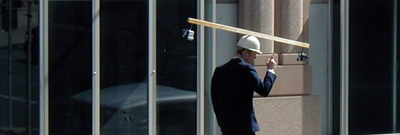
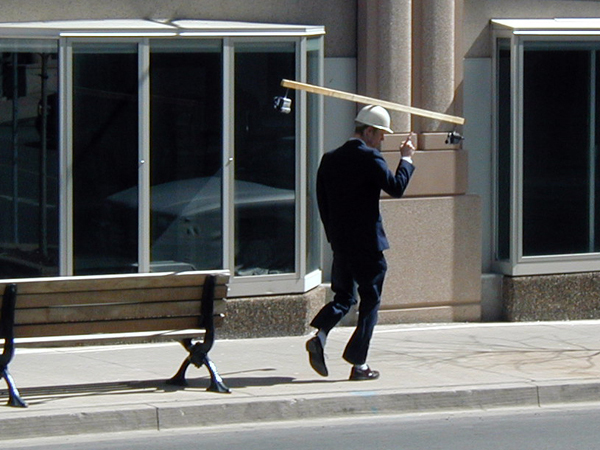
I recently saw a man in a three-piece suit, walking confidently, wearing a white construction helmet that balanced an eight-foot plank of wood with two video cameras attached on either end. I wasn’t the only one to be baffled by the sight. It turned out that most people around me stopped in their tracks with puzzled but smiling faces and asked the same questions; “what is he doing? What’s going on?” From a distance I watched with another curious pedestrian and began a conversation. Together we tried to figure it out, had a good laugh and in the process we learned a little bit about each other.
For those of us brave enough to step outside of our daily routine, we were greeted by a friendly man with a German accent. When I asked the question “what are you doing?” he answered; “I’m working…are you working today?” A natural conversation ensued where I talked about my job and he explained more about his.
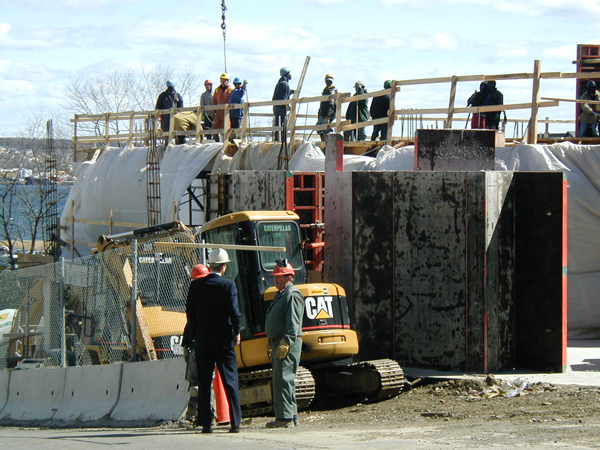
I found out that Stephan Schulz was genuinely interested in people’s lives and his “job” was to engage the general public and to create connections and relationships between individuals and himself. In this performance entitled Equally Distant from Both Sides he is documenting himself while ‘on the job’. In one of the video clips from the performance, Stephan talks to a couple of construction workers. They talk about their jobs, compare helmets and exchange a few tips. As a working artist, Stephan aligns himself with groups outside of the art world and at the same time his work functions within contemporary art discourse. In the process of art making, his work creates a dialogue with the various publics about our shared experiences.
Stephan uses commonplace technology and modifies it for his sculptural performances. He takes what is familiar and everyday and makes it strange. The element of the familiar makes the work accessible whereas the adaptation of the object for its new use entices wonder and intrigue. His work draws the viewer (or in this case the voyeur/participant) to raise questions about the object, the subject and the context in which the event is unfolding.
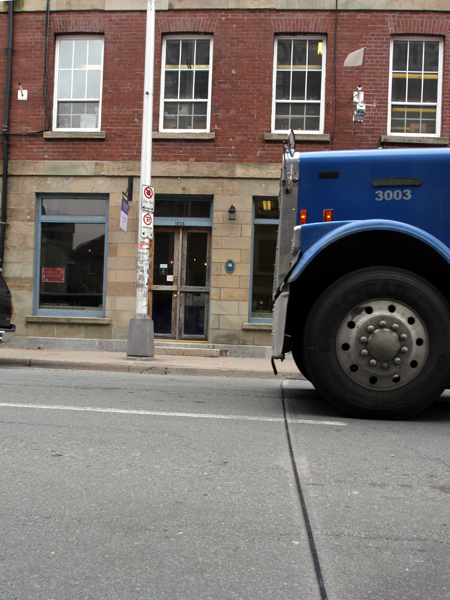
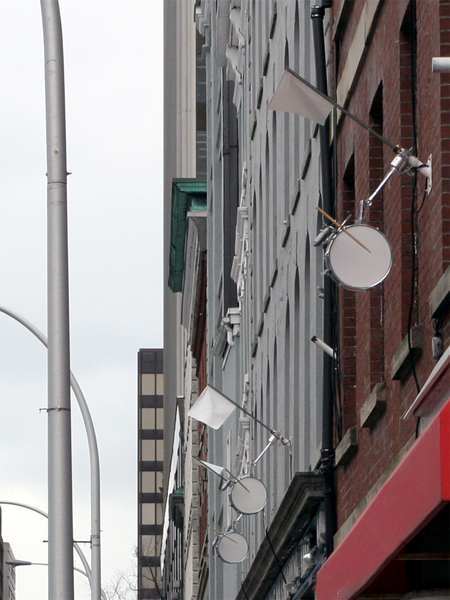
In a more recent outdoor sculptural intervention entitled Drum Line, Stephan merges standard technology used by the municipality with a few additional electronic components and a collection of identical snare drums. The municipality was kind enough to lend Stephan rubber hoses normally used for monitoring city traffic. The rubber hoses are directly connected to each of the shiny chrome snare drums which are hung from flag poles on a building’s facade. Each drum is equipped with a motorized drumstick.
By stepping or driving across a hose the inside pressure changes which then converts the tactile input into an electrical signal and triggers the corresponding snare drum. Pedestrians and drivers involuntarily take part in the creation of an outdoor drum rhythm. This rhythm is a direct translation of the movements taking place on the street.
Given that it is not unusual to see rubber hoses stretched along a street, cars and pedestrians carry on with their daily routines. It is only after hearing the rhythmic beats corresponding to traffic flow that people stop and take notice. The connection between the various elements is apparent and provokes participation. Some people cluster around the drums, heads tilted up while others stomp on the hoses in order to contribute to the percussive rhythms.
For Stephan, it is important for individuals to have a personal impact on their surroundings. Drum Line happens in a public space where people are normally isolated from each other, reinforced by the metal casings of their cars or by the noisy, bustling, busy city streets. Nevertheless, as Stephan points out, “outdoor public space holds the potential for engaging with a wider range of people and a wider range of opinions. It is necessary to allow for such spaces and such possibilities to exist especially in our technology driven culture. Technology seems to promote a culture of isolation, a culture in which we increasingly speak only to the like-minded. But in a public space we have the possibility to test out our opinions and see and hear others react to them.” Stephan calls into question the general notion that public space is predictable and immutable. The interventions strategically blend into their environments, which then serve as a platform to introduce the uncanny, or simply something new to consider.
These public interventions do not strive towards an abrupt social revolution, although they do offer an alternative way of perceiving and interacting within our urban spaces. As Stephan suggests, technology has enabled us to be more selective with whom we chose to connect with. In this case, Stephan uses technology to create links between people who would not normally ever connect. For the pedestrians who chose not to participate in the dialogue, they become voyeurs, observing each other in a highly constructed social context. In presenting to society a reflection of itself, we can assume that certain people might chose to navigate through the city with a heightened sense of their surroundings. Or, at the very least, they will go home with a funny story to talk about over dinner.
To see more documentation of Stephan’s work visit www.maybevideodoes.de.
Please click on the thumbnails above to enlarge each image.
Biography
Jennifer is a multidisciplinary artist based in Montreal. She completed her BFA at the University of Ottawa in 1997 and defended her MFA thesis at the University of Western Ontario on September 11th, 2001. She is the recipient of several grants and awards and her work has been exhibited across Canada. When she is not making art, she enjoys teaching and advocating for the arts. She has taught at the University of Western Ontario, Dundas Valley School of Art and has a strong background in artist-run culture.
Stephan Schulz was born in Berlin in 1978. He received a Masters in Interaction Design in 2004 from the UdK in Berlin and 2007 a M.F.A in Media Arts from NSCAD University in Halifax, Canada.
Stephan is a multi disciplinary artist who’s work uses electronic media to intervene into public space by combining elements of performance, sculpture and social interaction. He makes use of micro-controllers, custom made software and repurposed consumer goods. His publics works and gallery installations have been shown in Germany, North America and Columbia.
Stephan currently lives in Montreal and works for Antimodular Research, a new media art production studio headed by Rafael Lozano-Hemmer.